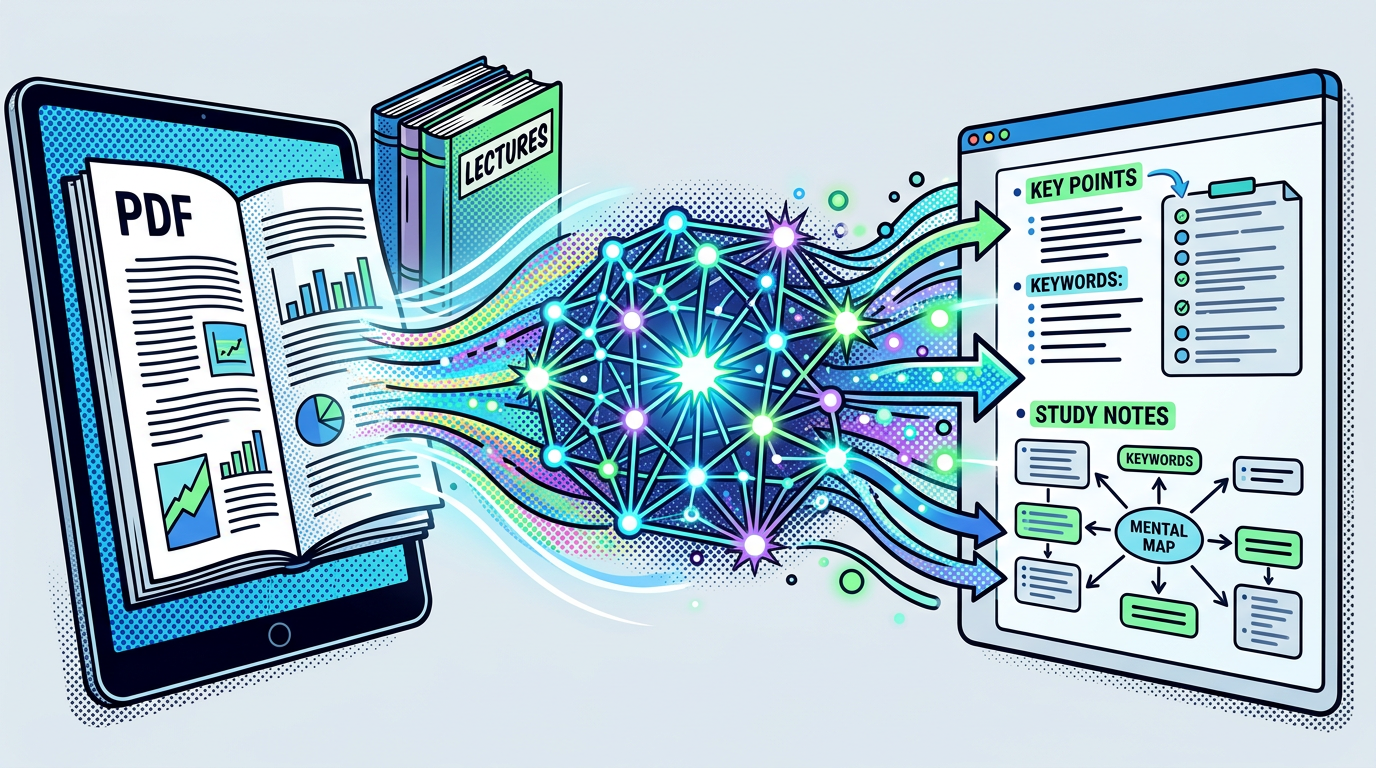
TL;DR: Good AI study notes aren't a shorter version of the source — they're a restructured one, with key concepts, comparisons, and cited sources, built to be tested on rather than reread. Here's the five-step process, and what to check before you trust what the AI gave you.
Every student has some version of the same problem: a PDF textbook chapter, a lecture recording, a professor's slide deck, and a stack of screenshots, spread across four apps and a dozen browser tabs, none of it in a shape you could actually study from. The material exists. What's missing is structure.
This is exactly the kind of work AI is good at — but only if you use it to organize the material, not just shrink it.
Why a plain "summarize this" isn't the same as real notes
Paste a chapter into a generic chatbot and ask for a summary, and you'll get a shorter version of the text. That's compression, not structure — and it comes with a real risk: general-purpose chatbots will often produce a confident, well-written summary that includes a detail they invented, with no way for you to tell which parts are trustworthy and which aren't. For a study set you're going to be tested on, that's a bad trade.
Real study notes need to do more than compress. They need to organize information the way you'll actually be asked to use it — and give you a way to check where it came from.
What good AI-generated study notes should actually include
- Structured sections, not one long paragraph — key concepts, definitions, and how ideas relate to each other.
- Comparison tables wherever the source is implicitly comparing things (causes vs. effects, term vs. term, before vs. after) — tables surface relationships that prose buries.
- Cited sources, so you can verify a claim against your actual textbook or a primary source instead of taking the AI's word for it.
- Follow-up questions, built in — the notes should hand you something to test yourself on, not just something to reread (see: why testing yourself beats rereading).
If what you got back is a single dense paragraph with no sourcing, it's a summary. What you want is a course.
Step by step: from raw material to structured notes
- Gather the source. A PDF, a textbook chapter, a lecture transcript, or just the name of the topic if you don't have a document to start from.
- Feed it to a tool built to structure, not just summarize. Holospark takes a topic, a PDF, or a video and turns it into notes with summaries, tables, key takeaways, and cited academic sources, rather than one compressed paragraph.
- Check the sources it cites. Cross-reference at least the parts you're least sure about against your syllabus or the original text — this takes two minutes and it's the difference between trusting your notes and hoping they're right.
- Convert the notes into something you're tested on, immediately. Don't stop at reading the structured notes once — turn them into flashcards or a quiz right away, before it becomes another thing to reread later.
- Schedule a spaced review. Revisit the same set a day later, then a few days after that, instead of only reading it once and moving on.
What to watch out for
AI notes are a scaffold, not a replacement for the work of understanding. Two things are worth being deliberate about:
- Hallucination risk. Any AI tool can occasionally state something incorrect with total confidence. Sourced, citation-backed notes give you a way to catch that; a plain summary with no citations doesn't.
- Don't skip straight to "done." Generating clean notes is the easy part. The learning happens when you close them and try to recall what's in them — the notes are the input to that process, not a substitute for it.
How Holospark helps: Paste in a PDF, a topic, or a lecture and Holospark turns it into structured notes — summaries, comparison tables, key takeaways, and citations to real academic sources you can check — in under a minute. It then turns those same notes straight into flashcards and quizzes, so step 4 above isn't a separate chore. Try Holospark free →
FAQ
Can AI actually make accurate study notes from a PDF? It can, but accuracy depends heavily on the tool. Tools that cite the sources they pulled information from let you verify accuracy; tools that only output a summary with no sourcing don't give you a way to check.
Is it cheating to use AI to make study notes? Generally no — organizing source material into notes is the same task you'd otherwise do by hand, faster. It becomes a problem only if you stop at generating the notes and skip actually studying them, which defeats the point regardless of how they were made.
What should I look for in an AI study notes tool? Structure over compression (tables and sections, not one paragraph), visible source citations, and a direct path from notes into something you're tested on, like flashcards or quizzes.
How do I check if AI-generated notes are actually accurate? Spot-check the claims you're least sure about against the original source — your textbook, the lecture, or the citation the tool provided. It takes a couple of minutes and it's worth doing before an exam, not after.
If you're working under time pressure, see our guide on how to catch up and study for finals when you're behind.