TL;DR: Rereading and highlighting feel productive but produce weak, short-lived memory. In a landmark study, students who tested themselves on new material remembered 61% of it a week later; students who reread the same material four times remembered 40% — despite spending less total time studying. This is why active recall (testing yourself) beats passive review, and how to actually build it into a normal study session.
Picture the most common way students "study": open the textbook or the lecture slides, read them once, then read them again, highlighter in hand, until the material starts to feel familiar. It feels like progress. The words stop looking foreign. By the third pass, you can practically finish the sentences before you get to them.
Then, a week later, in the exam, that same material feels like it was never studied at all.
This isn't a discipline problem. It's a measurement problem — rereading makes you feel like you know something, without actually testing whether you do. Psychologists call this the illusion of competence, and it's one of the best-documented gaps between how effective students think studying is and how effective it actually is.
The study that changed how we think about studying
In 2006, cognitive psychologists Henry Roediger and Jeffrey Karpicke ran an experiment that's since become one of the most cited findings in learning science. Students read a short passage under one of three conditions: rereading it four times in a row, reading it once followed by two practice recall tests, or reading it once followed by three practice tests.
Immediately after studying, the group that had only reread the passage actually predicted — and performed — the best. That's the trap: rereading produces a real, measurable short-term boost, which is exactly why it feels like it's working.
A week later, the researchers tested everyone again. The results flipped. Students who had practiced retrieving the information from memory retained about 61% of it. Students who had only reread it retained about 40% — a large gap, and one that appeared despite the rereading group spending more cumulative time with the material, not less.
Source: Roediger, H. L., & Karpicke, J. D. (2006). "Test-Enhanced Learning: Taking Memory Tests Improves Long-Term Retention." Psychological Science.
Why rereading feels like it's working (and isn't)
The mechanism here is fluency. The tenth time you see a sentence, your brain processes it faster than the first — and it interprets that speed as understanding. But recognizing something as familiar and being able to produce it from memory, unprompted, are two different mental operations. An exam almost never asks you to recognize whether a fact looks familiar. It asks you to produce the answer yourself.
Retrieval practice forces the second, harder operation every time. Each time you successfully pull something out of memory without looking, you strengthen the pathway to that information and — just as usefully — you find out immediately what you don't actually know, while there's still time to fix it. Rereading skips straight past that diagnostic step.
What active recall actually looks like
"Testing yourself" doesn't have to mean a formal quiz. In practice, it takes a few reliable forms:
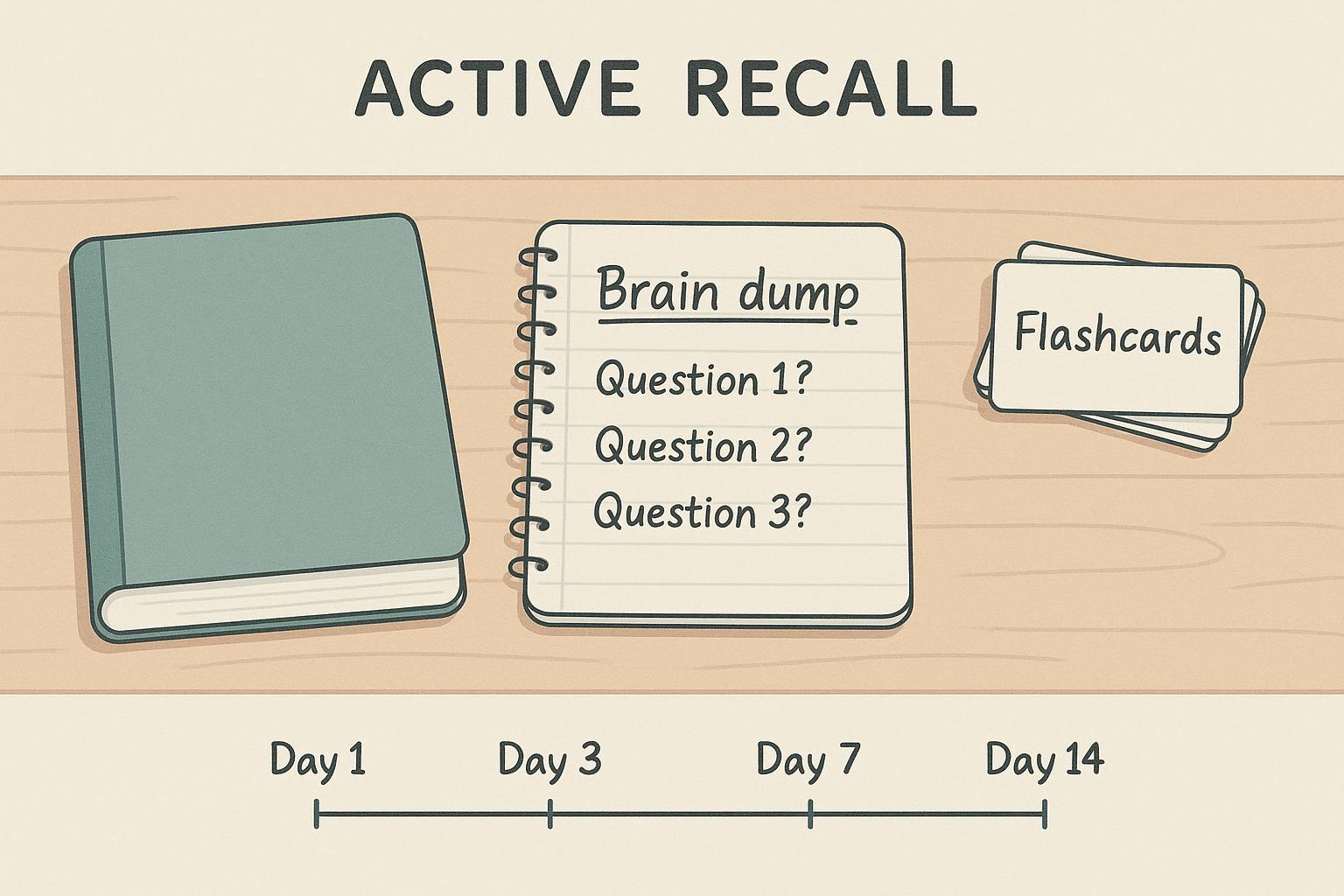
- Blank-page recall. Close your notes and write down everything you remember about a topic, unprompted, before checking what you missed.
- Real flashcards. The prompt should require you to generate the answer, not just recognize it when it's flipped over — if you're reading the answer side before you've genuinely tried to produce it, it isn't doing much.
- Practice questions and past exams. The closest simulation of what you'll actually be asked to do, and usually the highest-yield method available.
- Explaining it out loud, from memory, as if teaching someone who's never seen the material — you can't fake understanding you don't have when you're the one generating every sentence.
Not all recall is equally effective, either. Multiple-choice recognition — "which of these four terms is correct?" — is a weak form of retrieval, because the answer is sitting right there among the options. Free recall and short-answer formats, where you have to produce the answer with nothing to recognize, produce a much stronger effect.
How to build it into a normal study session this week
You don't need to redesign how you study. A few concrete swaps do most of the work:
- After a class or reading, close everything and spend five minutes writing down what you remember before you allow yourself to check your notes.
- Turn your notes into questions the same day you take them, while the context is still fresh — not the night before the exam, when it's a chore.
- End every study session, even a short one, with a blank-page recall of what you just covered. If you only add one habit from this article, add this one.
- Space your retrieval out over days rather than repeating it all in one sitting. A separate, large-scale analysis of 254 studies on distributed practice found that spacing reviews apart — instead of massing them together — produced 10–30% better retention than cramming the same amount of review into one session.
Source: Cepeda, N. J., Pashler, H., Vul, E., Wixted, J. T., & Rohrer, D. (2006). "Distributed Practice in Verbal Recall Tasks: A Review and Quantitative Synthesis." Psychological Bulletin.
Retrieval and spacing aren't competing techniques — they're the same recommendation from two different angles. Test yourself instead of rereading, and spread those tests out instead of bunching them together, and you're doing what the research actually supports.
How Holospark helps: The reason most students default to rereading isn't that they don't believe in active recall — it's that turning a set of notes into real quiz questions and flashcards by hand takes longer than just reading them again. Holospark removes that excuse: it turns any topic or set of notes into flashcards and quizzes automatically, and its AI tutor asks you to explain concepts back in your own words — a harder, more effective form of recall — and tells you exactly what you got right and what needs work. Try Holospark free →
FAQ
Is active recall really better than rereading for exams? For retention over days and weeks, yes — consistently, across multiple studies. Rereading can feel more effective in the moment because recognition is easy, but active recall produces significantly better delayed recall, which is what actually matters on exam day.
How often should I use active recall? At the end of every study session, at minimum. Ideally, revisit the same material again after a day, then after a few more days — spaced retrieval compounds.
Does active recall work for subjects beyond memorization, like math? Yes. For problem-based subjects, active recall means solving problems from memory without looking at a worked example first, not just recalling facts — the same principle, applied to procedures instead of definitions.
What's the difference between active recall and spaced repetition? Active recall is what you do — testing yourself instead of passively reviewing. Spaced repetition is when you do it — spreading that testing out over increasing intervals instead of all at once. They're most effective combined.
For more on turning your notes into structured study material, see our guide on how to turn a PDF into study notes with AI.